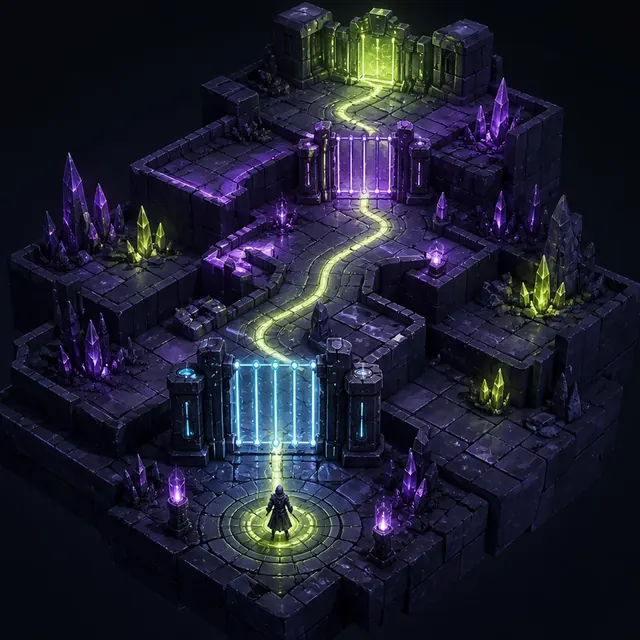
From a level contract to playtest evidence
- Level design
- Procedural content generation
- Navigation
- Playtesting
A level contract
sets path, pace and performance limits.
A model
proposes candidate layouts.
A playtest
measures whether the level works for players.
Write the level contract first
Define player abilities, critical path, optional paths, target completion time, encounter rhythm, accessibility needs and performance envelope. Separate hard constraints from preferences. Without this contract, novelty becomes the only visible success criterion and the team cannot explain why one proposal is better.
Generate structure before surface
Start with a graph, tile layout, tagged volumes or greybox. These intermediate forms expose connectivity and scale while edits remain cheap. Generating finished-looking environments too early anchors the team to decoration and hides traversal flaws behind atmosphere.
For the control model behind candidate layouts, compare procedural generation and generative AI, before deciding which constraints belong in code.
Automate the checks computers can perform
Validators can test disconnected critical paths, unreachable goals, slope limits, minimum clearance, spawn distance, sight-line proxies and budget counts. They do not establish fun, but they remove candidates that violate known rules before expensive review.
Use play evidence to close the loop
Instrument time to objective, deaths, route choice, backtracking and abandonment, then combine telemetry with observation and player explanation. Record seed, generator version and constraints so promising or broken layouts can be reproduced. Promote a candidate because of evidence, not because it was AI-generated.
Put navigation and streaming in the level contract
Traversal and loading are structural requirements, not a polish pass. Generated layouts should expose enough data for validators to reject blocked routes and impractical streaming boundaries early.
Define required routes
List entrances, exits, critical paths, optional loops and accessibility constraints before generating a layout.
Validate connected space
Test navigation data and gameplay reachability before art dressing makes a broken route expensive to replace.
Plan loading boundaries
Check that rooms, cells or world partitions fit the target memory and traversal plan under representative movement.
Test an AI-assisted level candidate
Write five hard constraints for a ten-minute level, then generate several greybox candidates under stored seeds. Reject disconnected or invalid layouts automatically before anyone dresses them. Have players run the surviving blockouts with identical abilities and record completion time, route choice, backtracking and confusion points. Compare the evidence to the original constraints before selecting a candidate for art production.
AI level design acceptance criteria
Goals, constraints and acceptance rules
Candidates and measurable validation
Observed player behavior
AI-assisted level design checklist
- Define a level contract with hard and soft constraints.
- Generate an editable structural representation.
- Run traversal and budget validators.
- Playtest with the target abilities.
- Store seed, version, edits and evidence.
Questions about AI-assisted level design
Can a model know whether a level is fun?
Not from appearance alone. Fun is contextual and must be evaluated through play, observation and design goals.
Why store the seed?
Reproducibility lets the team debug, compare and deliberately branch from a known proposal.
Where do navigation and streaming checks belong?
Put them in the level contract before generation. A layout should fail early if required paths are disconnected or if its cells cannot load within the target platform plan.
Apply this worlds & systems guidance
Give candidate layouts a visible performance envelope before art production: Estimate the generated level's scene envelope. When comparing proposal systems, keep the same constraints and use: Benchmark the generation workflow. This connects play evidence, technical limits and total iteration cost.
Layouts that pass validators still need play data; the automated playtesting guide for generated levels, shows how agents can exercise each candidate.
Primary sources & technical references
- PCG book: Search-Based Procedural Content GenerationOpen source ↗
- Mixed-Initiative Level Design with RL BrushOpen source ↗
- Generating Levels That Teach MechanicsOpen source ↗