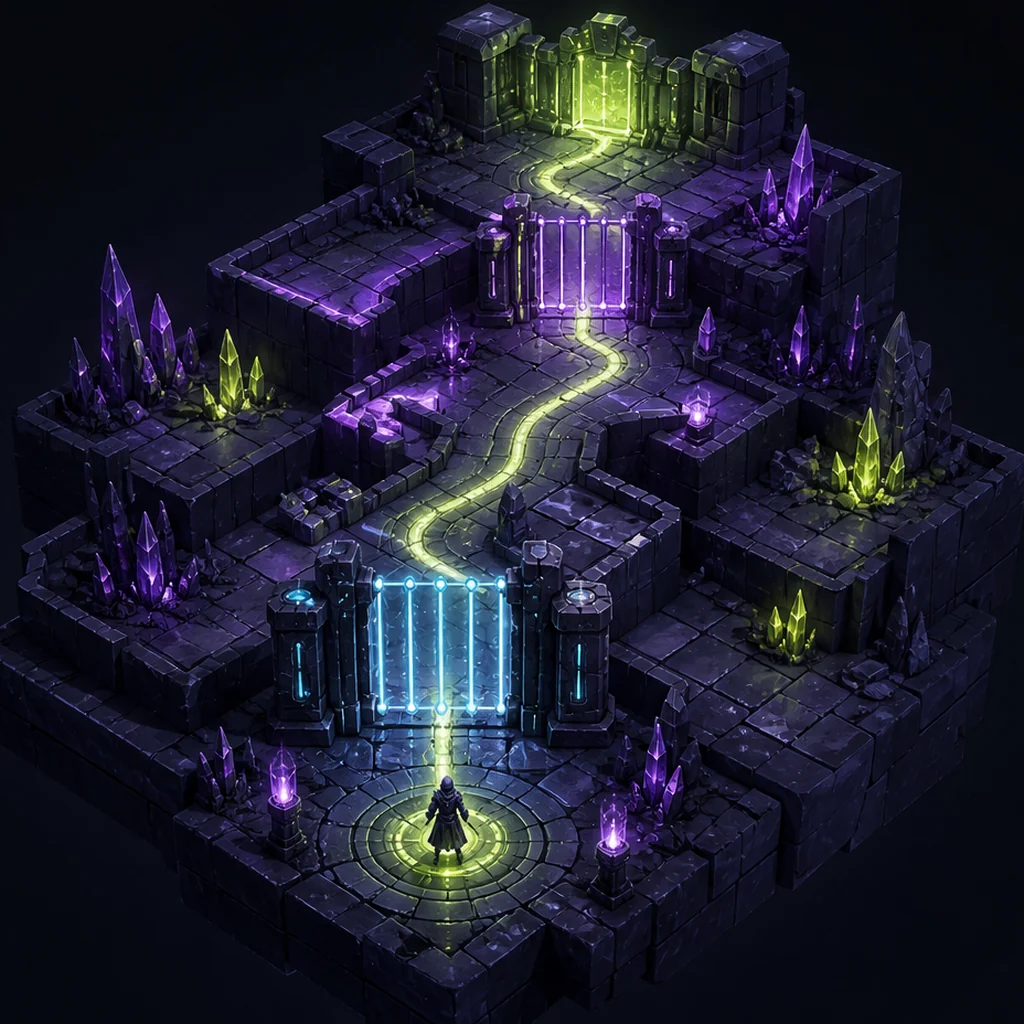
How rules, learned patterns and checks differ
- Procedural generation
- Generative AI
- Hybrid generation
- Constraint validation
Procedural generation
applies rules written by a designer.
Generative AI
samples patterns learned from data.
A hybrid system
combines broad ideas with hard checks.
Procedural generation, generative AI and hybrid systems compared
These methods differ most in where control lives. Choose by the guarantees, variety and debugging process the game requires.
| Decision | Procedural generation | Generative AI | Hybrid system |
|---|---|---|---|
| Control source | Authored rules, parameters and constraints | Patterns learned from training data | Learned proposals bounded by authored rules |
| Guarantees | Can encode hard structural guarantees | Requires validation because constraints may fail | Rules enforce failure-critical requirements |
| Reproducibility | Usually direct when code, parameters and seeds are stored | Requires model, version, settings, inputs and seed where available | Requires records from both components |
| Failure diagnosis | Inspect rules, parameters and solver behavior | Inspect inputs, outputs and repeated failure patterns | Trace whether proposal or validator caused rejection |
| Best role | Narrow systems that must remain predictable | Broad proposal spaces where accepted variety has value | Creative breadth with testable structural guarantees |
Procedural systems expose their rules
A grammar, noise function, solver or search algorithm is authored explicitly. Designers can inspect parameters and encode guarantees, such as every room being reachable. The cost is that variety remains bounded by the rules and assets the team creates.
Learned systems encode patterns implicitly
A trained generator can capture a broad style or propose unexpected combinations without hand-authoring every rule. Its failures are also less transparent. It may imitate surface regularities while missing functional requirements that were rare or absent in training data.
See those control choices applied to a playable space in the AI-assisted level-design workflow, where validators and playtests close the loop.
Hybrid design separates proposal from guarantee
A language model might turn a narrative beat into a tagged room graph; a constraint solver then ensures connectivity and pacing. An image model might develop mood references while modular kits construct valid geometry. This division places creative breadth where it helps and deterministic checks where failure would break play.
Compare control, not fashion
Measure reproducibility, constraint satisfaction, iteration speed, editability, runtime cost and the team's ability to diagnose failure. A simpler authored generator is often better for a narrow repeatable system. A learned component earns its place when it adds accepted variety that the team could not produce as efficiently otherwise.
Compare rule-based and learned generation
Model the same small dungeon twice: once with an explicit room grammar and once with a learned or language-driven proposal step. Give both the same connectivity and pacing validators. Compare valid-output rate, meaningful variety, designer edit time and the effort required to diagnose a broken result. A hybrid opportunity often becomes clear where one method supplies breadth and the other supplies guarantees.
Procedural versus generative AI decision matrix
Explicit rules and parameters
Patterns learned from data
Learned proposals plus authored guarantees
Hybrid game-generation checklist
- List guarantees the system must always satisfy.
- Choose explicit rules for failure-critical structure.
- Use learned generation where variation has value.
- Keep an editable intermediate representation.
- Benchmark accepted variety and debugging time.
Questions about procedural generation and generative AI
Is procedural generation AI?
The terms overlap historically, but modern generative AI usually refers to learned models, while procedural generation often means authored algorithms.
Can the two run at runtime?
Yes, if performance, determinism, moderation and platform constraints are handled; many pipelines instead generate and approve content before release.
When is a hybrid generator useful?
A hybrid is useful when a learned model adds meaningful variety while authored rules can enforce connectivity, budgets, safety or other requirements that must not fail.
Apply this worlds & systems guidance
If representation terminology is obscuring the comparison, begin with: Review the main generative 3D representations. Then evaluate both approaches under one controlled method: Compare generation systems with one test plan. The useful result is a documented control tradeoff, not a universal winner.
Both approaches meet at world scale in AI terrain and world generation, where heightfields, biomes and streaming budgets interact.
Primary sources & technical references
- PCG book: Search-Based Procedural Content GenerationOpen source ↗
- Mixed-Initiative Level Design with RL BrushOpen source ↗
- Boosting Mixed-Initiative Co-Creativity in Game DesignOpen source ↗