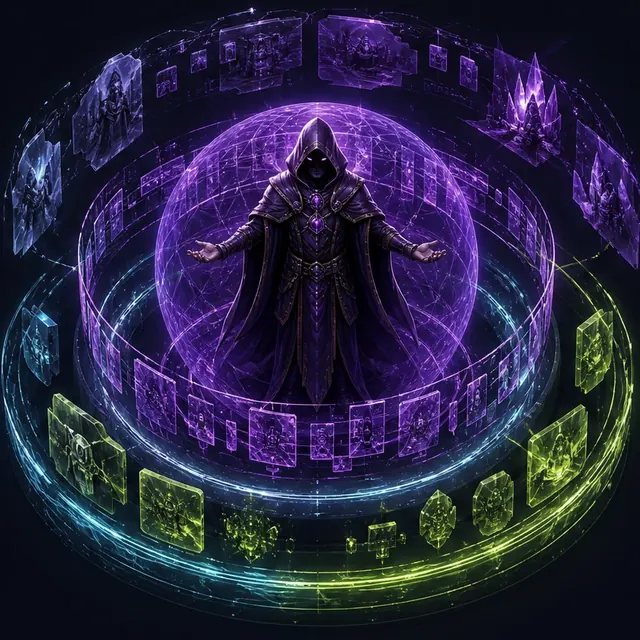
From authored canon to tested dialogue
- AI narrative system
- Authored canon
- Game dialogue
- Regression testing
Authored canon
sets facts the system must keep.
A model
generates bounded dialogue or quest text.
Regression tests
check safety, memory and lore behavior.
Separate authored truth from generated expression
Store world facts, quest state and inventory in authoritative game systems. Let the model express or interpret those facts rather than inventing state that gameplay cannot honor. This prevents a character from promising an item, door or quest branch that does not exist.
Memory is a product decision
Short context, retrieved lore, player summaries and long-term character memories have different privacy, cost and continuity consequences. Decide what is stored, for how long, who can inspect it and how a player can reset or delete it. Summaries should not silently become authoritative facts.
Any narrative action that changes gameplay should follow the explicit mechanic specification, instead of allowing generated text to become hidden game state.
Design refusals and outages into the fiction
Inputs can be abusive, unsafe, off-topic or technically unserviceable. The game needs graceful bounded responses, cached alternatives and a deterministic path when generation times out. A mechanic that disappears without a network connection should be treated as an online service dependency.
Test narrative behavior as a distribution
One successful conversation proves little. Build suites for canon contradictions, prompt injection, sensitive topics, repetition, latency, cost and state mismatch. Evaluate across model updates and representative player language. Human narrative owners should approve thresholds and review escalated failures.
Grounding generated dialogue in authored canon is the game-specific form of retrieval-augmented generation, so the retrieval layer, not the model's memory, decides what counts as true in the world.
Test an AI narrative system across repeated runs
Create a twenty-case narrative regression set before connecting a model to a game. Include canon questions, invented inventory requests, unsafe input, prompt injection, repeated questions, timeouts and old save state. Define the acceptable response or safe fallback for each case. Run the same suite after every model, prompt, retrieval or memory change and preserve failures for narrative and safety review.
AI narrative system design criteria
Game state and authored lore
Expression and bounded proposals
Moderation, fallback and regression tests
AI narrative system testing checklist
- Keep game state outside the language model.
- Define lore retrieval and memory retention.
- Create moderation and escalation rules.
- Provide deterministic timeout and offline fallbacks.
- Regression-test behavior across model versions.
Questions about AI narrative systems
Should an NPC remember everything?
No. Retain only what has a clear design and privacy purpose, with controls appropriate to the data.
Can generated dialogue be canon?
It can be bounded by canon, but any state-changing consequence should pass through authoritative rules.
What should happen when the model is unavailable?
The game needs an authored fallback that preserves state and player safety. A timeout should not invent a quest change, lose progress or block the main loop.
Apply this worlds & systems guidance
Generated dialogue and narrative assets still need a documented rights boundary: Record rights and provenance for generated content. Behavior changes should also run through a stable evaluation set: Build a repeatable system benchmark. Store failures alongside the model, prompt, retrieval and memory versions that produced them.
Dialogue that becomes behaviour belongs to generative AI NPC agents, with explicit memory, action and safety limits.
Primary sources & technical references
- Boosting Mixed-Initiative Co-Creativity in Game DesignOpen source ↗
- NIST AI 600-1: Generative AI ProfileOpen source ↗
- OWASP: Prompt InjectionOpen source ↗