How terrain layers become a testable game world
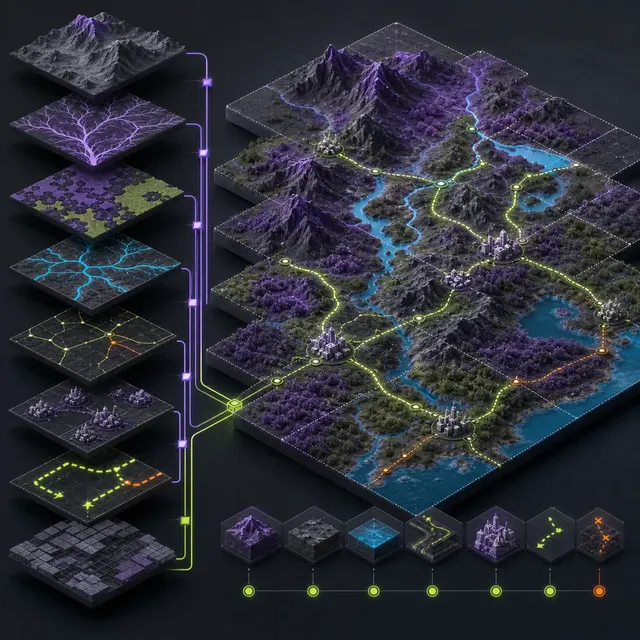
- Terrain generation
- Procedural content generation
- Height field
- Biome mask
- Hydrology
- World partition
- Navigation mesh
A learned terrain proposal
creates candidate spatial fields.
A deterministic world graph
combines water, biome, roads, landmarks and exclusions.
Seeded validation
tests traversal, streaming and runtime behavior.
Terrain is a stack of dependent fields
Elevation affects water flow; water and climate affect biomes; slope affects roads, buildings and traversal. A plausible height image is only the first layer. Define world bounds, vertical range, player movement, landmark needs and streaming units before generation. Store height, erosion, water, biome, exclusion and placement masks separately so a designer can correct one system without regenerating the entire world.
Blend learned proposals with explicit procedural rules
Learned systems can suggest large-scale forms or local surface character. Procedural graphs remain useful for guarantees such as minimum route width, settlement spacing, biome exclusions and seeded placement. Unreal's PCG framework documents spatial data and graph-based world-building workflows, while research such as InfiniteDiffusion explores learned unbounded terrain with seed-consistent access. Neither removes the need for project-specific constraints and engine validation.
Separate learned proposals from authored guarantees with the procedural-versus-generative comparison, before building a mixed terrain graph.
Validate topology of the playable world
Check that required regions connect, slopes fit movement abilities, rivers reach valid basins or exits, roads cross water deliberately and landmarks remain visible from intended approaches. Build navigation and run reachability tests across seeds. Test the worst combinations, not only attractive maps. When a rule rejects a world, preserve the seed and failing layer so the generator can be fixed instead of silently rerolled until a good screenshot appears.
Treat streaming and ecology as production systems
Partition the world using the engine's runtime strategy and test boundary continuity, repeated assets, memory, shaders and collision on target hardware. Biome variety should not create uncontrolled material and foliage combinations. Separate offline generation from runtime variation; shipping a model inside the game adds latency, determinism, safety and platform questions. Version the graph, seed and derived world together so a content change can be rebuilt and reviewed.
Stress-test ten generated terrain seeds
Generate ten seeds for one small world region using fixed bounds and landmark requirements. Retain every height, water and biome field. Run slope, route, river and navigation checks, then load the accepted and worst failing seeds through the same streaming path. Document which constraint caught each failure and whether a graph edit fixes it without damaging previously accepted seeds.
World-generation layer and control decisions
Suggests terrain form or surface patterns
Enforces spatial dependencies and authored rules
Tests traversal, streaming and performance across seeds
AI terrain and world-generation checklist
- Define traversal, vertical range and world boundaries.
- Store height, water, biome and placement fields separately.
- Use deterministic rules for required connections and exclusions.
- Test reachability and failure seeds.
- Profile streaming cells and repeated content on target hardware.
Questions about AI terrain and generated worlds
Should a generated terrain be accepted from its beauty render?
No. Traversal, hydrology, navigation, streaming and target performance require separate evidence.
Is AI terrain generation the same as procedural noise?
No. Learned and procedural methods can both produce terrain, but they expose different controls and failure modes and often work best together.
Why keep failed seeds?
They make constraint failures reproducible and help improve the generator rather than hiding defects through rerolling.
Apply this worlds & systems guidance
Choose the control method for every world layer: Choose which controls belong in learned or procedural systems. Then validate traversal and difficulty through: Test generated spaces across agents and human play. The generator is useful when failures are reproducible and designers can repair a layer without losing the world.
Primary sources & technical references
- Unreal Engine: Procedural Content Generation FrameworkOpen source ↗
- InfiniteDiffusion terrain-generation researchOpen source ↗
- PCG book: Search-Based Procedural Content GenerationOpen source ↗
- Mixed-Initiative Level Design with RL BrushOpen source ↗