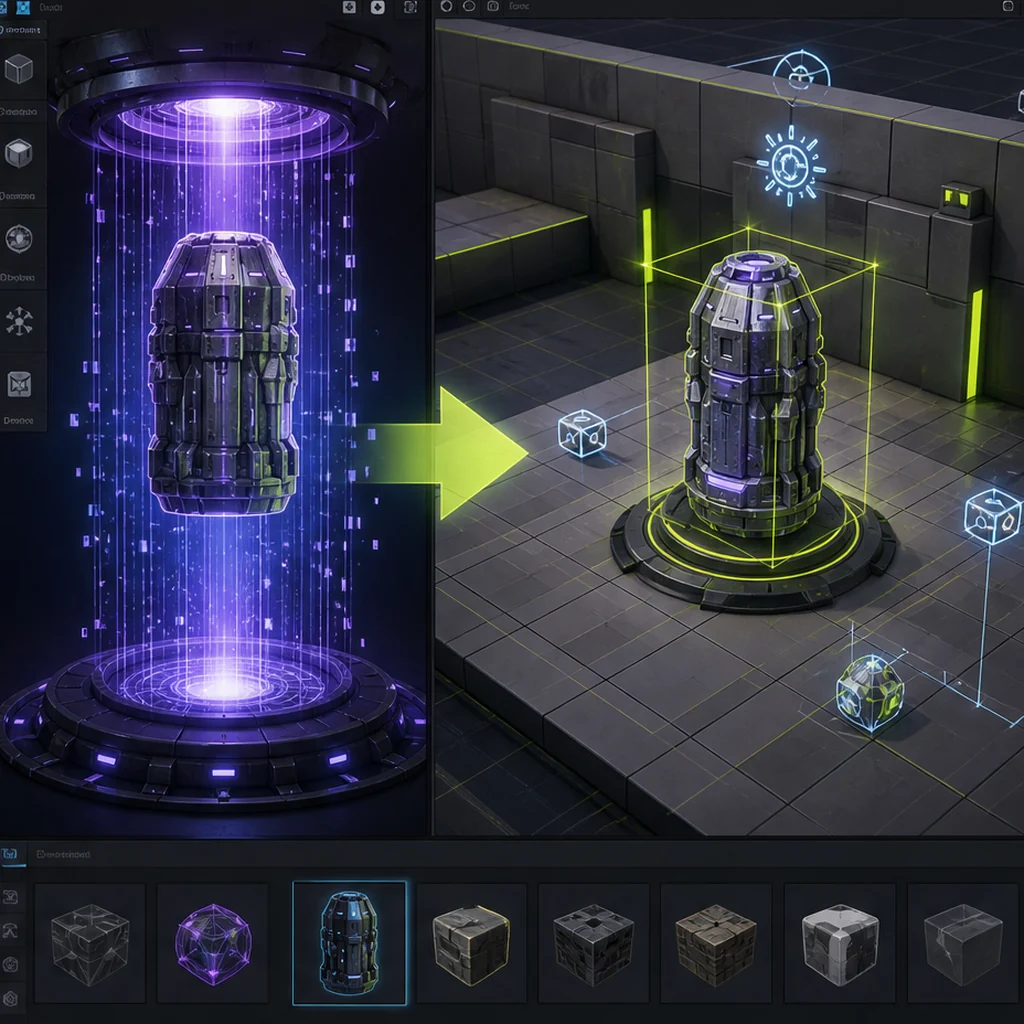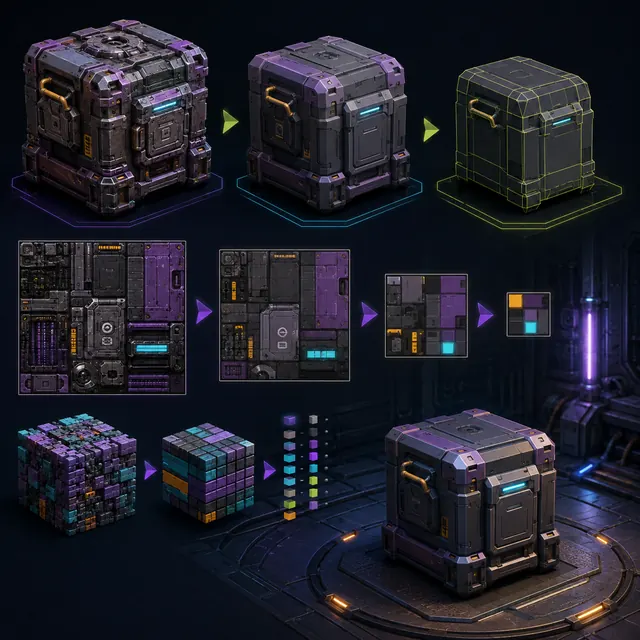
How delivery and runtime optimization differ
- 3D asset compression
- Level of detail
- Draco
- KTX 2.0
- Basis Universal
- Texture memory
Geometry compression
reduces the delivered representation size.
Texture encoding
affects transfer size, decoded memory and visible quality.
Representative profiling
measures the complete scene cost on target hardware.
What each optimization changes
Choose an optimization only after naming the cost it is meant to reduce.
| Technique | Primary target | Does not prove | Validation |
|---|---|---|---|
| Mesh LOD | Rendered geometry at distance | Smaller download or better materials | Moving-camera scene test |
| Draco geometry compression | Transfer and storage bytes | Lower decoded triangle count | Decode support and load test |
| KTX 2.0 / Basis textures | Portable compressed texture delivery | Acceptable quality in every channel | Target-GPU material test |
| Fewer material slots | Draw and authoring complexity | Correct batching in every renderer | Representative scene profile |
Separate download size from runtime cost
A compressed package can be small on disk while expanding into substantial GPU memory. Geometry compression mainly changes storage and transfer; it does not automatically reduce the triangle count drawn after decoding. Texture containers can reduce transmission and support GPU-ready formats, but the chosen encoding, mip chain and platform support determine memory and quality. Record file size, decoded resources and frame behavior separately.
Reduce geometry by camera evidence
Build LODs around the expected screen size and preserve the features that control silhouette and recognizable shape. Remove hidden and micro geometry only when it cannot affect shadows, collision or close views. Review transitions during motion and with the final material. A percentage ladder is a starting hypothesis; the representative camera path decides whether a lower-detail mesh is acceptable.
Use the 3D asset planning tools, to turn geometry, texture and instance assumptions into visible starting budgets before profiling.
Treat textures as a coordinated budget
Choose dimensions from texel density and viewing distance rather than assigning the same resolution to every map. Generate mipmaps and test normal, roughness and packed channels under the target renderer's color-space and compression rules. Khronos defines KTX 2.0 and Basis Universal workflows for portable GPU texture delivery, but actual support and quality settings must be confirmed in the destination.
Profile repeated assets on the lowest target
An isolated prop hides instance count, shader variants, overdraw, shadows and animation cost. Place realistic quantities in a representative scene, move the camera through expected distances and measure memory, frame timing and visible LOD changes. Save the source, optimization settings and target hardware so a later tool or engine upgrade can reproduce the decision.
Measure one asset from transfer to runtime
Choose one repeated scene asset and record its source geometry, texture set, material count, delivery size and representative-scene performance. Create two LODs based on actual camera distances, then test a target-supported texture and geometry compression path. Compare transfer size, decoded memory, visible quality and frame behavior separately; do not combine them into one unexplained optimization score.
3D asset optimization decision points
Stored or transmitted bytes
Geometry processed at distance
Decoded texture memory and sampling cost
3D geometry and texture optimization checklist
- Record transfer size and decoded runtime memory separately.
- Build LODs around gameplay screen size.
- Set texture dimensions from texel density and distance.
- Verify compression support in the target runtime.
- Profile realistic instance counts on the lowest target device.
Questions about 3D asset compression and runtime cost
Does Draco reduce rendered triangle count?
No. Draco compresses transmitted or stored geometry data; the decoded mesh still needs an appropriate runtime geometry budget.
Do smaller texture files always use less GPU memory?
No. File compression and decoded GPU format are different measurements, so inspect the runtime representation.
Should every asset use the same LOD percentages?
No. Protect silhouette and gameplay meaning at measured distances; different asset classes need different reductions.
Apply this production & trust guidance
Set initial measurable envelopes in: Estimate LOD, texture and scene budgets. Then enforce the stable file and resource rules through: Prevent budget regressions with automated validation. A smaller download is accepted only when decoded quality and runtime behavior also pass.
Primary sources & technical references
- Khronos glTF specification and resourcesOpen source ↗
- Khronos KTX texture-container specification and toolsOpen source ↗
- Khronos glTF Draco mesh-compression extensionOpen source ↗
- Unity Manual: importing modelsOpen source ↗
- Unreal Engine documentation: importing contentOpen source ↗