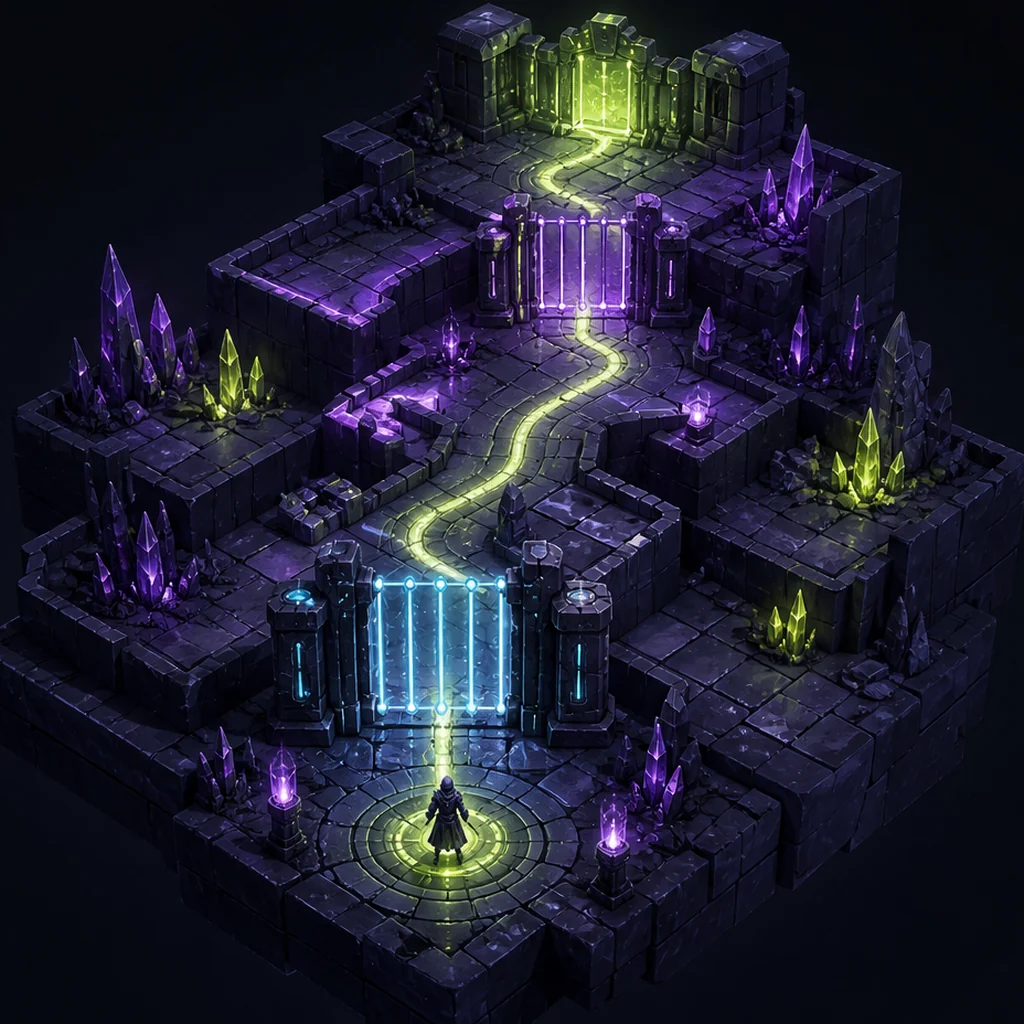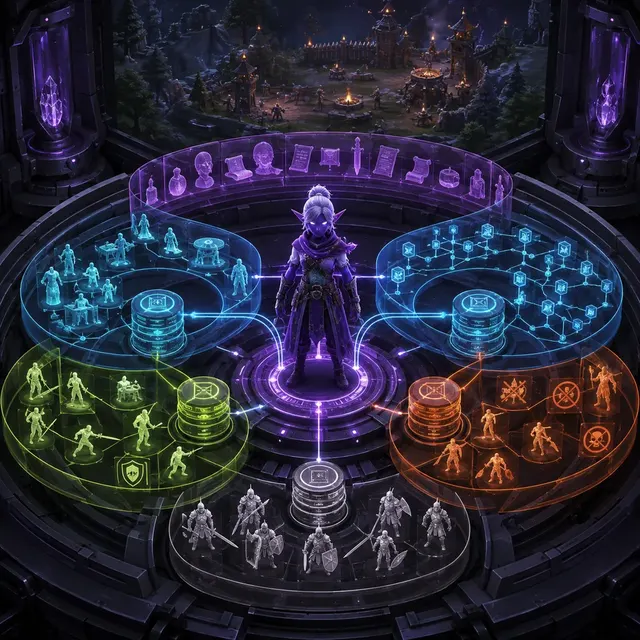
How a bounded generative NPC connects to the game
- Generative agent
- Non-player character
- Retrieval-augmented generation
- Prompt injection
- Game state
- Structured action
- Content safety
Authoritative game systems
provide approved state and available actions.
A scoped generative layer
proposes dialogue and structured intent.
A deterministic validator
controls state changes, safety responses and fallback behavior.
Believable language is not authoritative game state
Research on generative agents explores observation, memory, reflection and planning for believable simulated behavior. A shipped NPC still needs a stricter boundary: the model may propose speech or intent, but inventory, quests, combat, economy and world facts remain owned by deterministic systems. Retrieve only the information required for the scene and label it by authority so generated dialogue cannot invent a reward or alter canon by merely saying it happened.
Memory needs limits, provenance and forgetting
Separate authored biography, current scene observations, short conversation history and durable player-specific facts. Store only information the product is allowed to retain, define expiry and deletion, and never let untrusted player text rewrite the system rules. Summaries can lose qualifiers or introduce false facts, so keep links to source events when durable memory matters. A character should admit uncertainty or fall back rather than manufacture inaccessible world knowledge.
Use the canon and fallback controls in the AI narrative-systems guide, before adding persistent memory or autonomous planning.
Convert model output into a narrow action contract
Ask for a structured intent chosen from allowed verbs such as speak, move-to, offer-known-quest or play-authored-animation. Validate arguments, permissions, cooldowns, distance and current state in ordinary game code. Tool responses return facts; the model does not directly execute arbitrary commands. OWASP identifies prompt injection as a core risk for language-model applications, making input boundaries and least-privilege actions production requirements rather than optional polish.
Test the character as a stateful system
Create adversarial player prompts, lore contradictions, repeated conversations, unavailable services and long sessions. Measure response time and cost separately from narrative quality. Verify that safety refusals remain in character without trapping progress, and that deterministic dialogue or behavior keeps the game playable offline or during provider failure. Human review should examine stereotyping, harassment, age suitability and whether apparent memory matches the actual retention policy.
The pattern is the general one behind any AI agent, a loop of perception, decision and tool use, which in a game must stay inside the rules the simulation already enforces.
Red-team one bounded NPC prototype
Prototype one shopkeeper with ten approved facts and four allowed actions. Run a script of normal, contradictory and injection-style player messages, then disconnect the model service. Record invented facts, invalid action attempts, latency and whether the fallback preserves the shop and quest flow. Fix the contract and retrieval rules before expanding memory or adding more characters.
Generative NPC architecture boundaries
Owns canon, rules and durable game facts
Proposes language and bounded intents
Permits only legal state changes and fallbacks
Generative AI NPC safety and state checklist
- Keep canon and game state in authoritative systems.
- Separate biography, observation, short memory and durable facts.
- Allow only validated structured game actions.
- Test prompt injection, contradictions and service failure.
- Provide deterministic narrative and gameplay fallbacks.
Questions about generative AI NPC agents
Should an NPC language model change quest state directly?
No. It may request an allowed intent, but deterministic game logic should validate and apply every state change.
Does a longer memory make an NPC better?
Not automatically. More retained data can increase contradictions, privacy exposure, latency and irrelevant context.
What happens when the model is unavailable?
The character needs an authored fallback that preserves required information and lets the player continue.
Apply this worlds & systems guidance
Design the authored narrative boundary in: Define canon, retrieval and narrative fallbacks. Keep gameplay state transitions explicit with: Keep generated intents outside executable mechanic rules. An engaging performance is accepted only when state, safety and fallback behavior also hold.
Primary sources & technical references
- Stanford HCI: Generative AgentsOpen source ↗
- OWASP: Prompt InjectionOpen source ↗
- NIST AI 600-1: Generative AI ProfileOpen source ↗
- Unity ML-Agents official repository and documentationOpen source ↗