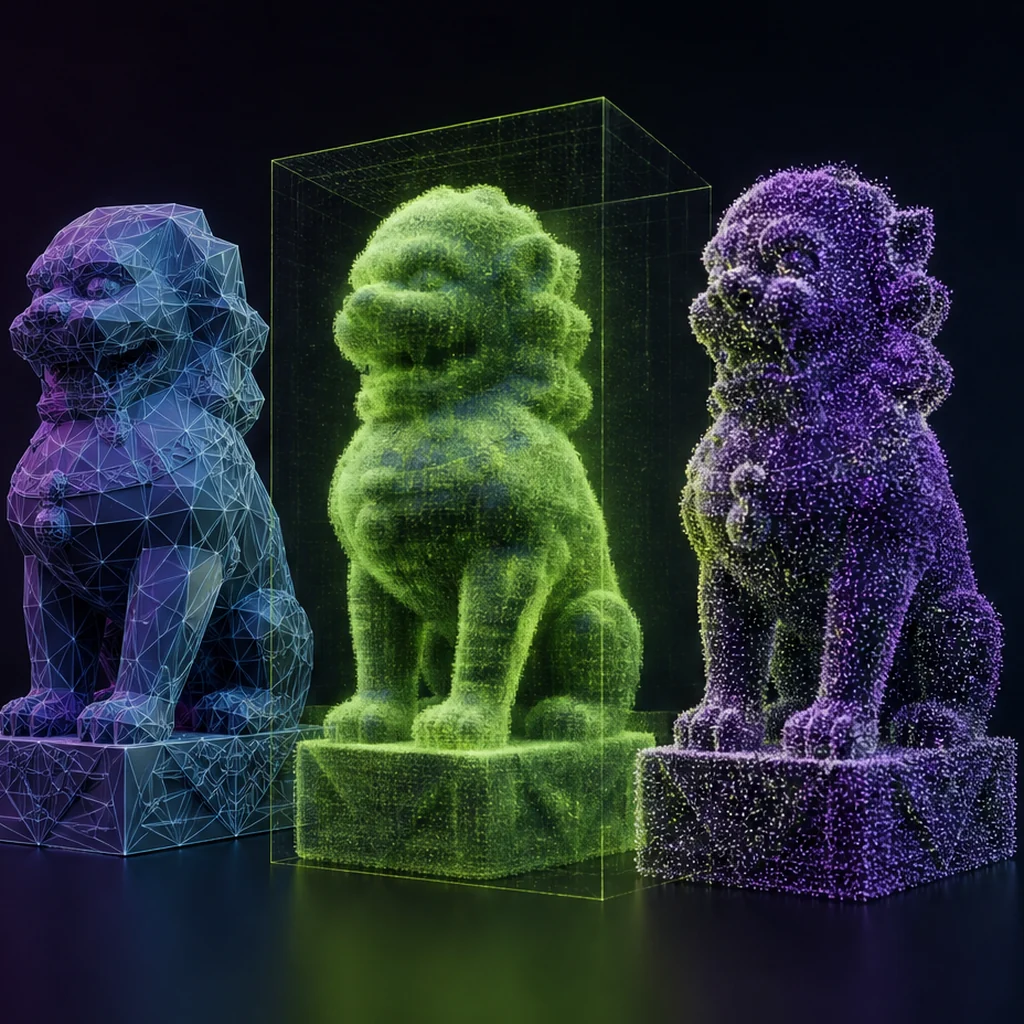
How data, model route and evaluation connect
- 3D training data
- Objaverse-XL
- Score distillation sampling
- Conditional diffusion model
- 3D evaluation metrics
- Game asset acceptance
A training corpus
shapes the concepts and 3D structures a model can learn.
A generation route
produces a specific spatial representation under named conditions.
A multi-part evaluation
tests rendered alignment, geometry and production usefulness separately.
Training data defines the model's reachable world
A 3D corpus may contain meshes, materials, scene graphs, renders and uneven metadata. Scale alone does not make the collection suitable: duplicate objects, uncertain licenses, broken topology, sparse categories and weak captions change what a model can learn. Objaverse-XL demonstrates the scale now available to 3D research, while a production reviewer still needs a model card or provider statement that explains sources, filtering, permitted use and known gaps. Dataset disclosure is evidence about scope, not proof that every output is safe or accurate.
Direct generation and score distillation learn differently
Shap-E encodes 3D assets into implicit-function parameters and trains a conditional diffusion model over that learned representation. DreamFusion instead showed how a pretrained text-to-image model can guide optimization of a new 3D scene through score distillation and differentiable renders. These routes create different latency, consistency and export tradeoffs. Ask whether each request runs a model forward, optimizes a scene over many steps, reconstructs observations or combines several stages before comparing speed or quality.
See the generation routes in how text-to-3D works, before interpreting a speed or quality comparison.
One metric cannot describe a useful 3D result
Text-image similarity can reward a recognizable render while missing duplicated faces or a hollow back. Geometric distances need a reference shape and can behave differently across point density and alignment. Human preference can capture visual appeal but varies with camera, material and instructions. A useful research evaluation reports several dimensions: semantic alignment, view consistency, geometry, material behavior, diversity, failure rate and compute conditions. A game pipeline adds cleanup time, export reliability and acceptance in the target scene.
Production evaluation begins after the benchmark render
Freeze held-out prompts and asset roles before testing. Retain every attempt, seed when available, tool version, timing boundary and original export. Inspect untextured turntables, silhouettes, normals, UVs and hidden surfaces, then run the file through the same engine scene and asset gates used for authored work. Report the sample and limitations beside the result. This prevents a research metric, a selected gallery image and a shippable-asset decision from being treated as interchangeable evidence.
Much of this vocabulary is borrowed from 2D and language research; read a plain definition of a foundation model, then judge which parts of a 3D result come from general pretraining and which come from 3D data.
Design a small multi-dimensional 3D evaluation
Choose five held-out asset briefs that cover rigid, organic and thin geometry. Run the same attempt limit for one system, preserving rejected outputs and settings. Score prompt alignment, cross-view consistency, visible geometry defects, export success and cleanup minutes separately. Import every surviving candidate into one neutral validation scene. Publish the scoring sheet and sample boundary before summarizing the result.
Evidence needed at each model stage
Data sources, filtering, representation and rights
Generation route, version, settings and compute
Export, cleanup, engine behavior and acceptance
Generative 3D training and evaluation checklist
- Identify the training and generation route disclosed by the system.
- Use held-out briefs and retain every attempt.
- Measure alignment, consistency, geometry and diversity separately.
- Evaluate the exported file under neutral conditions.
- Record cleanup, import and final acceptance beside model metrics.
Questions about training and evaluating generative 3D models
Does a larger 3D dataset guarantee a better model?
No. Coverage, annotations, rights, filtering, duplicates and representation quality matter alongside object count.
Can CLIP similarity prove that geometry is correct?
No. An image-language score measures rendered semantic alignment and can miss hidden or structural defects.
Why keep rejected generations?
They reveal reliability and retry cost; a selected success alone cannot establish typical production behavior.
Apply this 3d ai foundations guidance
First understand how a new spatial result is produced: Trace the main text-to-3D generation routes. Then keep the evaluation conditions and failures in: Record a reproducible production comparison. Research metrics inform the test; the exported asset and declared game role decide acceptance.
Primary sources & technical references
- Allen Institute for AI: Objaverse-XLOpen source ↗
- DreamFusion project and paperOpen source ↗
- OpenAI Shap-E repository and paperOpen source ↗
- NVIDIA GET3D researchOpen source ↗