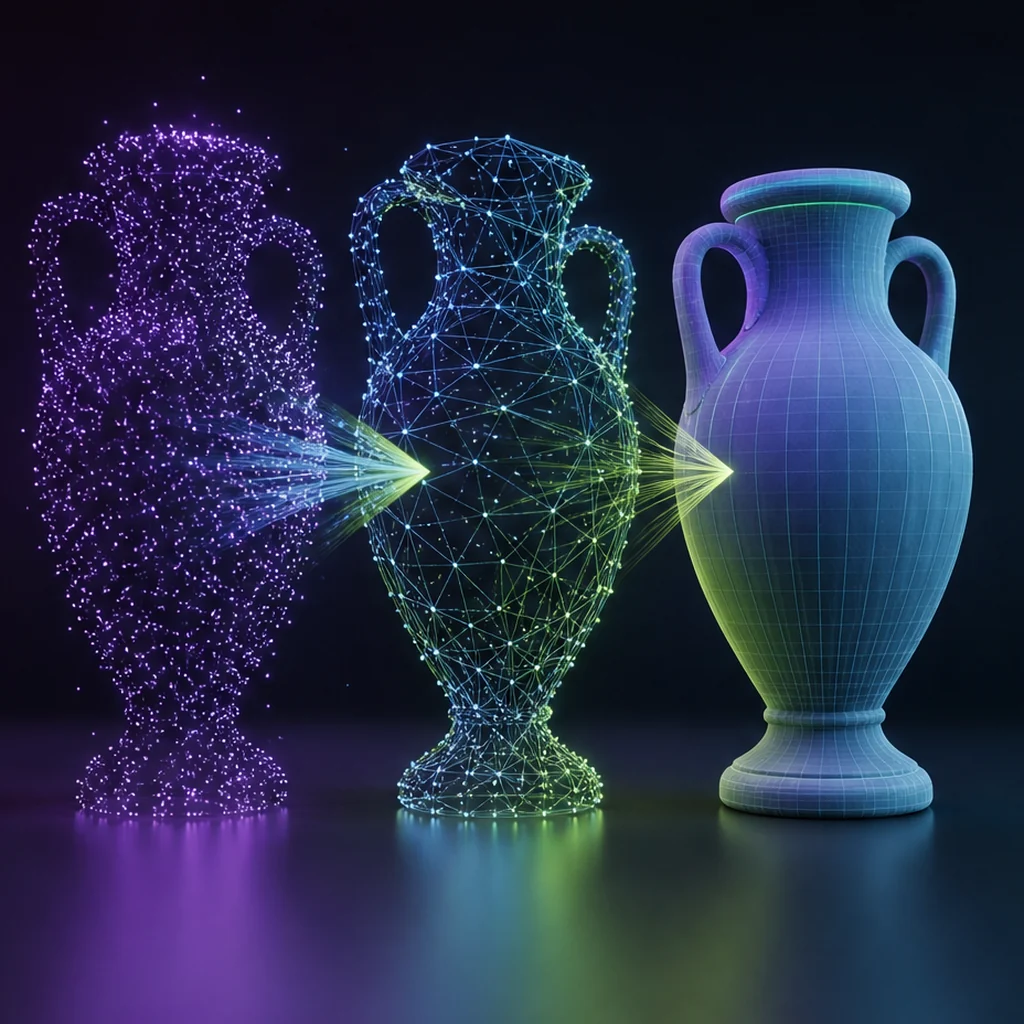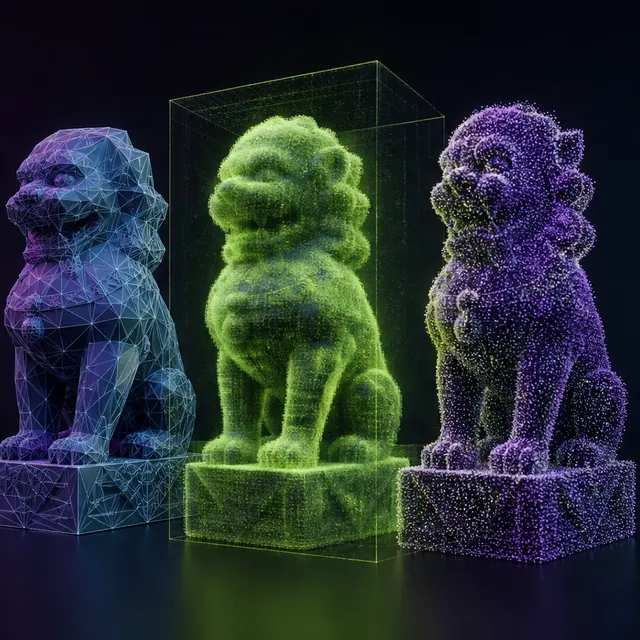
How meshes, NeRFs and splats store a scene
- Neural radiance field
- 3D Gaussian splatting
- Polygon mesh
- Real-time rendering
A mesh
stores visible surfaces as vertices and faces.
A NeRF
models how light looks through a scene.
Gaussian splats
represent a scene with many small 3D primitives.
Mesh, NeRF and Gaussian splatting compared for game use
The right representation depends on what the player, editor and renderer must do with the result. Use this comparison before judging visual quality.
| Production question | Polygon mesh | NeRF | Gaussian splats |
|---|---|---|---|
| What is stored? | Explicit vertices, edges and faces | A neural function for density and appearance | Explicit 3D Gaussian primitives with appearance data |
| How is it edited? | Directly in established DCC and engine tools | Usually through specialist tools or conversion | Primitive editing is possible, but production tooling is less conventional |
| Collision and animation | Works with standard engine collision, skinning and rigging workflows | Usually needs converted or separate geometry | Usually needs proxy or converted geometry |
| Relighting | Uses normal material and lighting pipelines | Captured appearance can limit relighting | View-dependent captured appearance can limit relighting |
| Best starting fit | Editable objects and gameplay-critical surfaces | Captured view synthesis where scene appearance matters | Captured scenes that need fast novel-view rendering |
Meshes describe surfaces explicitly
Vertices and faces give DCC tools and engines a shared structure for UVs, skeletal deformation, morph targets, collision and LOD authoring. That mature toolchain is the mesh's biggest advantage. Its limitation is that complex view-dependent appearance and captured detail must be approximated through geometry, textures and shaders.
NeRFs learn radiance through space
A neural radiance field estimates color and density as a function of position and view direction. NeRF research produced striking novel-view synthesis from calibrated images, but the original representation is not an ordinary surface asset. Rendering cost, scene editing and relighting require different techniques from standard mesh production.
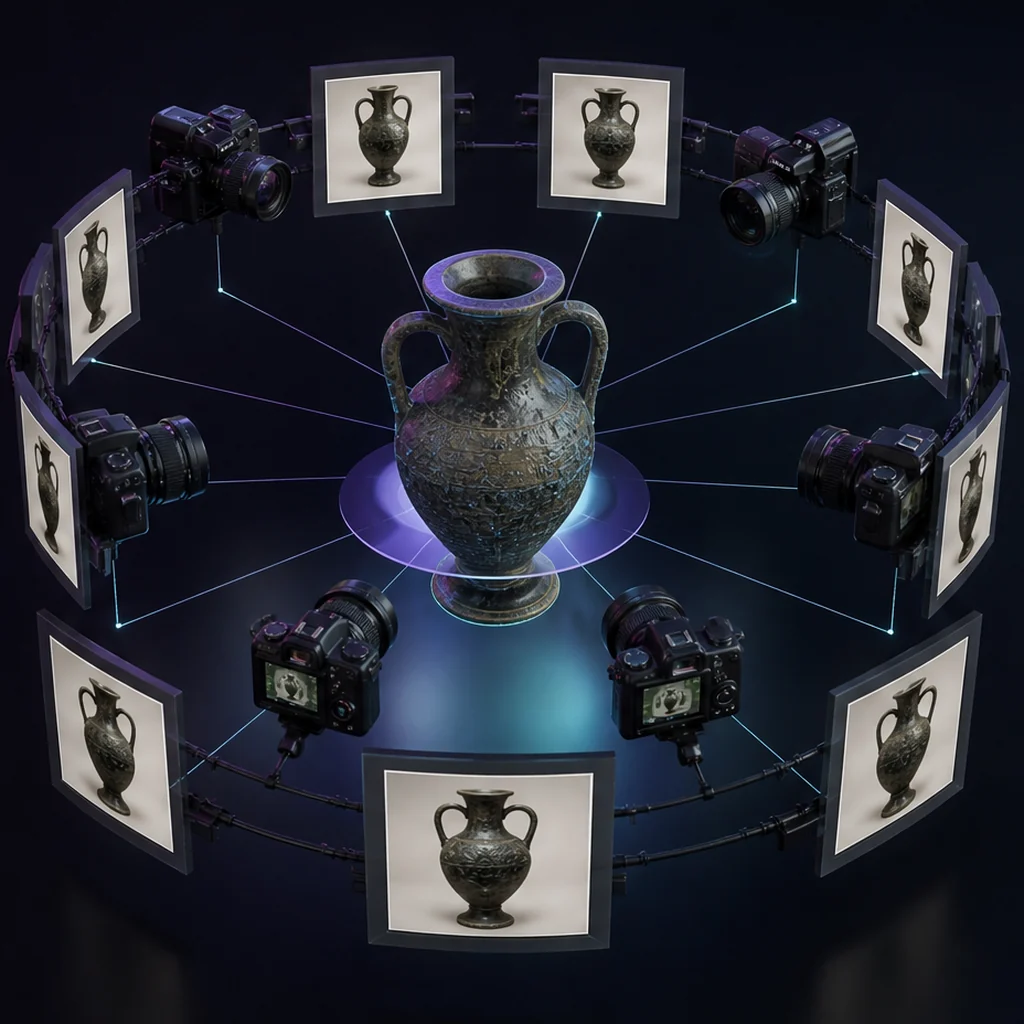
When the source is a camera set, continue with image-to-3D reconstruction, to separate capture evidence from representation choice.
Gaussian splats trade networks for explicit primitives
3D Gaussian Splatting represents a captured scene with many position, covariance, opacity and color primitives. It can render captured appearance efficiently on capable hardware and has become useful for spatial capture. The representation can still be heavy, difficult to relight and unsuitable for conventional skeletal animation.
Use a decision matrix
Choose by interaction. A pickup item needs collision, animation hooks and strong LOD behavior: prefer a mesh. A digital-tour background may prioritize captured appearance: splats or a neural field may fit. A hybrid can use captured representation for distant context and authored meshes for interactive surfaces. Test on the lowest target device.
Compare a mesh, NeRF and Gaussian splat
Pick a small scene and list every action the player or engine must perform: collide, relight, animate, destroy, stream, occlude and run on the minimum device. Score mesh, neural field and Gaussian splats against those requirements with an explicit pass, conversion needed or fail. The winning representation should follow from interaction and deployment needs rather than the most photoreal still frame.
3D representation decision matrix
Best general-purpose editability
Neural view synthesis
Explicit captured radiance primitives
3D representation selection checklist
- List required interactions and lighting changes.
- Set memory and frame-time budgets.
- Test target platform support.
- Plan collision and occlusion behavior.
- Define a fallback representation.
Questions about meshes, NeRFs and Gaussian splats
Can Gaussian splats be edited?
Yes, but the editing model and tools differ from conventional surface modeling, and semantic changes may require reconstruction or specialized operations.
Can a NeRF be converted to a mesh?
Geometry can be extracted or approximated, but the conversion may lose view-dependent detail and require cleanup.
Which representation is simplest for collision?
A mesh is usually the most direct starting point because game engines already use surface or simplified mesh geometry for collision. NeRFs and splats commonly need conversion or separate collision assets.
Apply this 3d ai foundations guidance
If the representation begins with captured views, first improve the evidence: Score an image-to-3D capture set. If the final deliverable must become an editable surface asset, continue with: Audit a converted mesh for game use. That sequence separates capture quality from the later cost of conversion and cleanup.
Primary sources & technical references
- NeRF project page and paperOpen source ↗
- INRIA 3D Gaussian Splatting researchOpen source ↗
- Khronos glTF specification and resourcesOpen source ↗