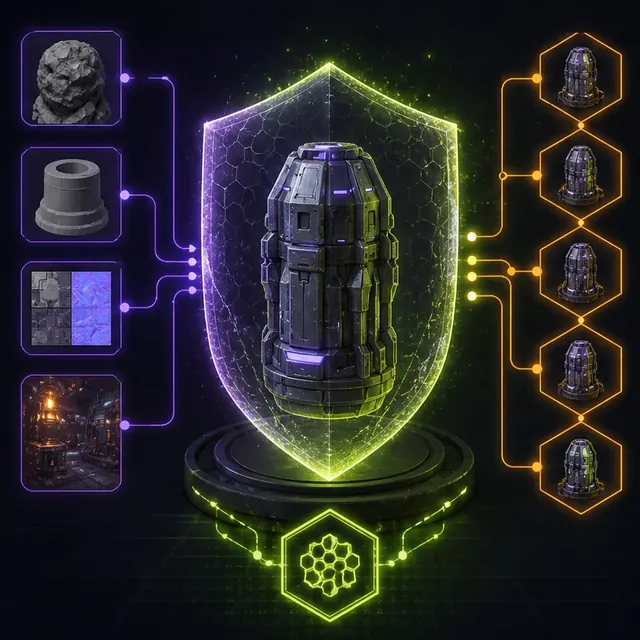
From source rights to a reviewable asset record
- Copyright
- Asset licensing
- Content provenance
- C2PA
Source rights
govern how each input may be used.
Human edits
record creative choices and contribution.
A provenance record
connects inputs, tools, approvals and files.
Separate four different questions
Ask whether the output has copyright protection, whether using it could infringe another work, whether the tool contract grants suitable commercial rights, and whether confidential inputs are retained or reused. A favorable answer to one does not resolve the others.
Document human creative contribution
Retain sketches, briefs, selected references, prompts where appropriate, intermediate versions and substantial modeling, sculpting, texturing or compositing work. The goal is an honest production record, not a performance for registration. Requirements differ by jurisdiction and continue to develop.
Attach rights evidence to the same test record described in the AI 3D benchmark guide, so legal and technical acceptance stay connected.
Track every input's authority
Record creator, license, permitted uses and source URL or contract for reference images, scans and datasets supplied by the team. A public image is not automatically licensed for commercial adaptation. Do not use employee, client or community content outside the permissions under which it was collected.
Preserve machine-readable provenance where useful
C2PA Content Credentials can bind assertions about an asset and its edits to cryptographic manifests, but they are one layer of evidence rather than a complete rights decision. Internal asset records should also identify model, version, operator, date, approvals and final file hashes.
Treat tool terms as versioned production dependencies
Commercial permissions, input handling and retention terms can change. A current terms page cannot prove which agreement applied to an asset created months earlier.
Record the applicable terms
Save the provider, account tier, model version, date and terms reference used for the production decision.
Separate contract from copyright
A tool may grant contractual use rights without resolving copyright protection or possible infringement questions.
Escalate material uncertainty
Send unclear ownership, confidentiality or source-permission questions to qualified counsel before release.
Build a provenance record for one AI game asset
Choose one released or release-candidate asset and reconstruct its rights file. Identify every human-created input, generator and version, account terms in force that day, intermediate edit, reviewer and final hash. Mark every missing fact. Repeat on a traditionally created asset for comparison. The gaps show which provenance fields the pipeline must capture automatically before the next production cycle.
AI game asset rights review
Protection in the output
Risk from sources or similarity
Rights and duties under tool terms
Copyright, licensing and provenance checklist
- Read the tool's current commercial and data terms.
- Verify rights for every supplied input.
- Retain evidence of human creative decisions and edits.
- Record model, version, operator, date and approval.
- Get jurisdiction-specific legal review for material releases.
Questions about AI game asset rights and provenance
Are AI-generated assets automatically public domain?
Do not assume so. Protection and use rights depend on facts, jurisdiction and contracts.
Does provenance prove ownership?
It can document history and assertions, but legal ownership and permission require separate analysis.
Which records should stay with an AI-assisted asset?
Keep source rights, authorized inputs, tool and version, applicable terms, operator, prompts where appropriate, human edits, approvals and a final file identifier or hash.
Apply this production & trust guidance
Attach the rights record to a technical approval created with: Create a reviewable asset acceptance record. The original intent and authorized inputs should be retained through: Document the brief and authorized inputs. Neither record proves ownership by itself, but together they make the production history reviewable.
Provenance records only help if they stay attached to each revision; see version control and reproducibility for AI-assisted assets, for a workable repository layout.
Primary sources & technical references
- U.S. Copyright Office AI initiativeOpen source ↗
- C2PA technical specificationOpen source ↗