How source, exchange and runtime assets differ
- glTF
- GLB
- FBX
- Wavefront OBJ
- OpenUSD
- 3D asset interchange
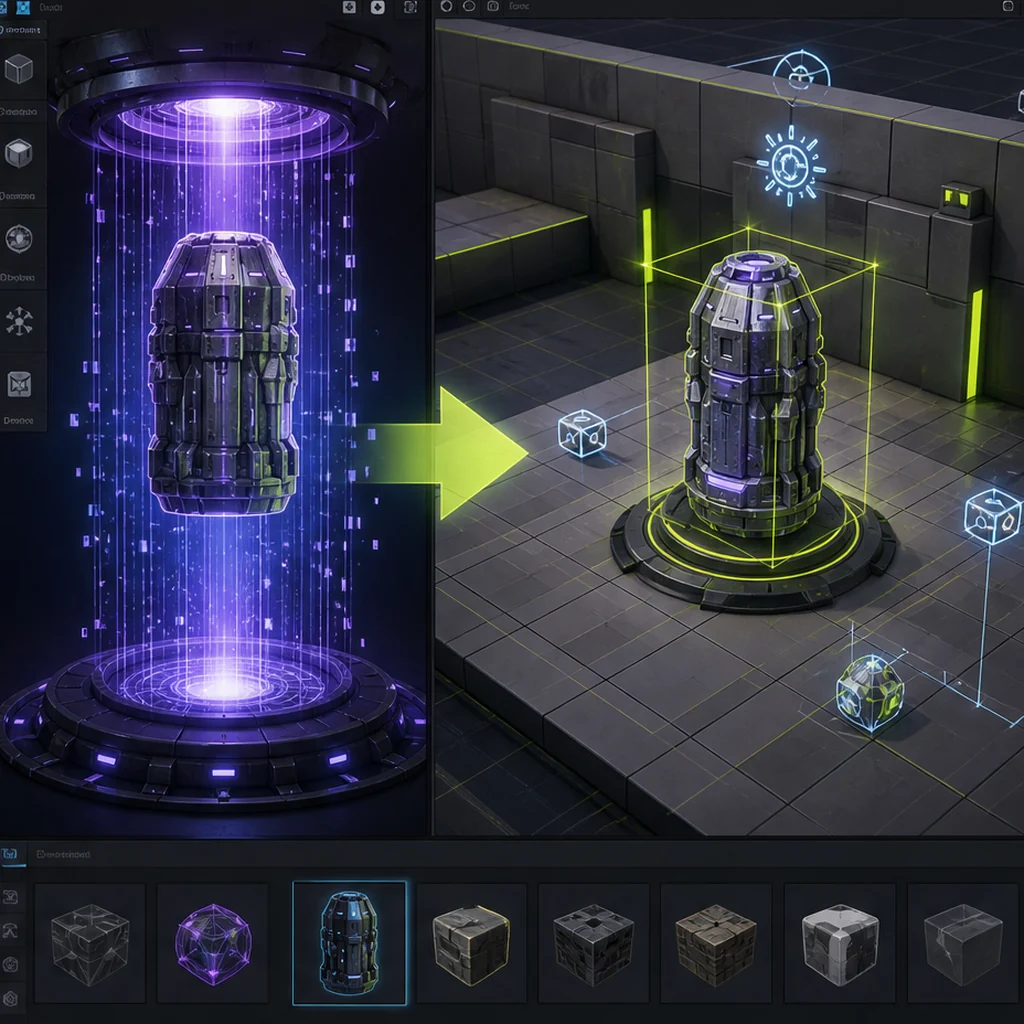
An editable source
retains the data needed for later authoring.
An interchange format
moves a defined feature set between tools.
An engine importer
creates a runtime-specific derived asset.
glTF, FBX, OBJ and USD at a glance
This is a starting decision map, not a replacement for an exporter-to-importer test.
| Format | Primary production fit | Common strength | Main caution |
|---|---|---|---|
| glTF / GLB | Real-time asset delivery | Specified PBR and extensible runtime package | Unsupported extensions may be dropped |
| FBX | Established DCC and engine exchange | Broad adoption in animation pipelines | Implementation behavior is tool-dependent |
| OBJ | Simple static mesh handoff | Readable geometry and UV interchange | Limited hierarchy, materials and no skeletal animation |
| USD | Large composed scenes and collaboration | References, variants and scene composition | More pipeline complexity than a single prop may need |
Separate working source from delivery format
The richest editable source belongs in version control even when the engine receives a smaller exchange file. Flattening a scene for delivery can remove modifiers, procedural construction, linked assets or nonstandard metadata. Define which file remains authoritative, which file is generated for interchange and which engine artifact is derived. This prevents a convenient export from becoming the only recoverable source.
Choose by the data that must survive
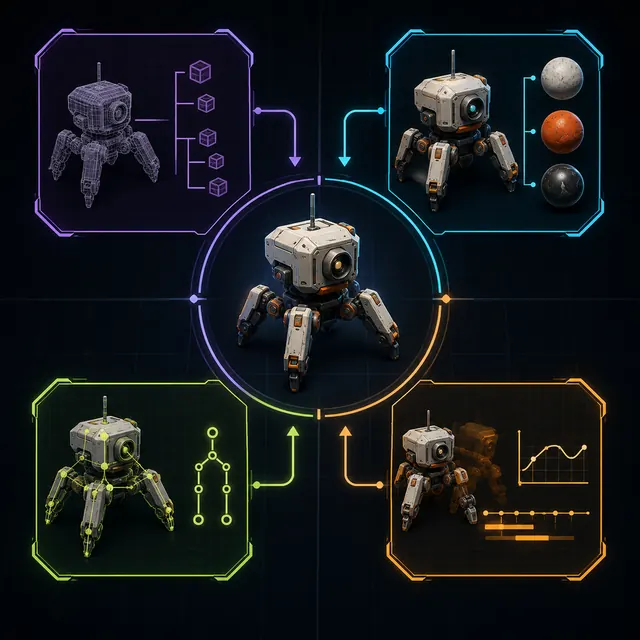
A static prop may need geometry, normals, UVs, PBR materials and transforms. A character adds bones, skin weights and animation. A modular scene may need hierarchy, instances, variants and references. Write that list before comparing formats. A format can support a feature in principle while a particular exporter, extension or engine importer drops or transforms it.
Clean geometry and source structure first with the Blender cleanup workflow, so a format test does not confuse source defects with conversion loss.
Understand the practical strengths
glTF is specified for efficient runtime asset delivery and has defined PBR and extension mechanisms. FBX remains common in established DCC and engine pipelines, but behavior depends heavily on the implementing tools. OBJ is widely readable and transparent enough for simple geometry, yet it does not carry a modern complete scene or animation contract. OpenUSD is a scene-description and composition system for scalable interchange and collaboration, not merely a single-file mesh replacement.
Run a feature-by-feature round trip
Create a small reference asset containing hierarchy, pivots, named materials, textures, one skeletal clip if required and a known unit scale. Export, reopen in a clean DCC scene and import into the engine. Compare transform, normals, tangents, UV sets, materials, animation, naming and warnings. Record the exact versions because changing an exporter or importer can change the result without changing the extension.
Round-trip one representative 3D reference asset
Build one small reference asset with two named parts, a deliberate pivot, two UV sets, two PBR materials and one short skeletal animation when the project needs characters. Export it through every candidate format, reopen each file in a clean DCC session and import each into the target engine. Record missing hierarchy, changed units, material remapping, animation differences and warnings before choosing the pipeline format.
3D file-format decision criteria
Specified real-time asset delivery
Established tool-dependent scene and animation exchange
Simple static geometry interchange
Composed, scalable scene description
3D interchange-format checklist
- Name the authoritative editable source.
- List required hierarchy, material and animation features.
- Check target-engine importer support.
- Round-trip one representative reference asset.
- Record exporter, importer, extensions and warnings.
Questions about glTF, FBX, OBJ and USD
Is GLB the same as glTF?
GLB is the binary container form of glTF and can package the main JSON description and binary resources into one file.
Is FBX always best for animation?
No universal format choice applies. Test the rigs, clips, constraints and importer behavior used by the actual project.
Should a game ship its editable source files?
Usually the build consumes derived runtime assets, while editable sources remain in the production repository under the team's versioning and rights controls.
Apply this production & trust guidance
Before exchange, prepare a clean editable source with: Prepare the authoritative source in Blender. After the format contract is known, enforce repeatable checks through: Turn round-trip requirements into automated gates. Keep the source, interchange and imported artifacts as separate versioned stages.
Primary sources & technical references
- Khronos glTF specification and resourcesOpen source ↗
- OpenUSD documentation and specificationsOpen source ↗
- Godot documentation: importing 3D scenesOpen source ↗
- Unity Manual: importing modelsOpen source ↗
- Unreal Engine documentation: importing contentOpen source ↗